
The "asset-right" strategy, reiterated by ITC chairman Sanjiv Puri during the company's 112th annual general meeting (AGM) on August 11, received a thumbs up from the analysts. They, however, believe that sustained earnings growth and synergies with the demerged hotel's vertical will help the stock break out from the ongoing consolidation. "The stock is expected to consolidate between Rs 420 and Rs 450 in the near future.

These 10 stocks represent the best mix of value and growth, offering relatively low price-to-earnings and price-to-book ratios, a high return on equity, and sufficiently high potential from current levels.

As rural demand tapers, companies are back at the drawing board, firming up plans to beat the unexpected slowdown in sales.
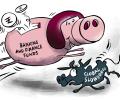
Even as banks and finance companies are reporting record-high earnings, their weighting in the benchmark National Stock Exchange Nifty50 Index has seen a downward trajectory. Investors expect a stronger performance from other sectors in the new year. Currently, banking, financial services and insurance (BFSI) companies collectively hold a weighting of 34.5 per cent, down from 36.7 per cent at the end of December 2022 and a record high of 40.6 per cent at the end of December 2019. This represents the sector's lowest weighting in the index since December 2021 when it stood at 33.7 per cent.

HUL has achieved few milestones in the fiscal gone by and hence is performing good on revenues front.

Analysts suggest investors remain in a wait-and-watch mode and not jump in to buy stocks across-the-board.

Operating margins have been the primary driver of corporate earnings in India in recent quarters, despite revenue growth suffering from weak consumer demand. Companies across sectors have reported a sharp improvement in earnings before interest, tax, depreciation, and amortisation (Ebitda) margins over the past two years, benefiting from lower commodity and energy prices. Higher margins more than compensated for slower revenue growth, resulting in double-digit growth in net profit for five consecutive quarters.

It's not only the Indian markets that command a valuation premium over their global peers; shares of subsidiaries of India-listed multinational companies (MNCs) also trade at rich valuations compared to their parent companies. An analysis of 12-month forward price-to-earnings (P/E) and price-to-book (P/B) multiples of domestically listed MNCs shows that most quotes have a premium ranging from 2.1x to 6x that of their parent. Similarly, P/B, in most cases, is significantly higher in the domestic market.

These stocks offer the best combination of maximum 'buy' recommendations from brokerages and share price upside over the next 12 months.

Players like UltraTech Cement more expensive than ITC and HUL; others catching up fast.

Experts point to the higher contribution of rural from the north for the growth reported by the region, a point endorsed by companies who've been pushing their presence aggressively there.

Manufacturing companies have been outperformers on the bourses in the current year, leading to a rise in their weighting in the benchmark index. Companies in sectors such as FMCG, automobile, pharmaceuticals, metals, cement, and agrochemicals now account for 25.43 per cent of the Nifty 50 index, up 88 basis points from 24.55 per cent at the end of December last year and a record low of 23.1 per cent at the end of CY20. The manufacturing sector is now dominated by FMCG majors such as Hindustan Unilever, ITC, Asian Paints, Nestle, and Britannia, accounting for 45 per cent of the combined market cap of all manufacturing companies in the index.

Even as the slowdown in the information technology (IT) services sector deepens, banking, financial services and insurance (BFSI), as well as oil and gas companies, emerge as the primary drivers of corporate earnings in the country. The IT services sector's share in corporate earnings declined to a five-year low of 17.4 per cent in the second quarter (Q2) of 2023-24 (FY24), whereas banks and finance companies accounted for 46.5 per cent, and oil and gas firms contributed 16.8 per cent. At their peak, IT services firms like Tata Consultancy Services (TCS), Infosys, HCLTech, and Wipro represented just over a third of the combined net profit of all listed companies in the Business Standard sample.

ITC has been one of the best performing large-cap stock at the bourses thus far in calendar year 2022 (CY22), rallying nearly 52 per cent during this period and outperforming the sector benchmark - the S&P BSE FMCG index - by a wide margin that moved up around 17 per cent during this period. However, the counter has lost over 5 per cent from its recent high of Rs 346.25 hit on September 23, 2022 and has underperformed the S&P BSE Sensex, which has lost nearly 2 per cent since then. So, is the rally in the stock coming to an end, and is this a good time to book profit?

Profits of India's top listed companies have been growing at a faster pace than those of their American peers, but when it comes to revenue growth, the order has reversed recently. The combined net profit of the S&P 500 companies was up 14.1 per cent year-on-year (Y-o-Y) during the trailing 12 months (TTM) ended December 2023, as against 17.4 per cent profit growth logged by the BSE 500 companies in the same period. This is the second consecutive year of faster profit growth for the BSE 500 companies.

'Only if the Budget springs some surprises we may see a halt in the selling.'

Household consumption recovered in urban India in May-July but remains weak in rural.

Hindustan Unilever's Q3FY24 performance was lacklustre, with both sales and operating profit barely moving from the year-ago period due to price cuts and higher advertising costs. Besides weak demand, the FMCG (fast-moving consumer goods) major is facing increased competitive pressures, particularly from regional players, which, coupled with a slow recovery in rural markets, could put revenues under pressure going forward. Margins are expected to remain range-bound as benefits from falling raw material costs are expected to be neutralised by rising promotional budgets.

Stocks of alcoholic beverage makers have corrected over the last few trading sessions on worries that taxes, competition and costs will hurt sales and profitability. The recent trigger for the decline is Karnataka, which accounts for 15 per cent of overall liquor consumption, increasing duties. The state increased by 20 per cent the additional excise duty on Indian-made foreign liquor (IMFL) on all slabs.
A hotel in 1975, entry into paperboards in 1979, India's dominant cigarette maker, ITC, read the tea - or tobacco - leaves early, leveraged its enterprise strengths and stepped up the diversification agenda to create multiple drivers of growth. Some failed, some faltered, some were transformational, adding steadily to the top line. Now those efforts are making a difference: margins from non-cigarettes - FMCG, hotels, agri, paperboards, paper and packaging - are expanding and profits are kicking in more significantly than ever before.

Growth numbers for the large players in the sector, though, improved during the quarter.

Among the lot, Rallis India, Escorts, Jubilant Life Sciences, and Crisil added half of the total gains made in the ace stock-picker's portfolio.

Sensex rises, Nifty holds 8,900; FMCG, Pharma shares lead.

Given the expectations of growth in the packaged foods segment, the company seeks to become a Rs 1-trillion FMCG business by FY30.

The stock of consumer goods major Emami has corrected nearly 3.5 per cent since its 52-week high of Rs 546.25. On August 29, the stock closed at Rs 521.90 on the BSE. After underperforming the Nifty FMCG index for a long time, the stock is now doing a catch up and surged over 13 per cent in the past one month.

India was the flavour of the year, at least in the FMCG sector, as multinationals hiked stakes in their subsidiaries lured by long term potential of the country, while homegrown executives made their way to top hierarchy of global firms in 2013.

The combined net profit of "early bird" companies, those that have declared their quarterly results, rose for the third consecutive quarter in July-September 2023 (Q2FY24). But the figures suggest a continued slowdown in revenue growth and stagnation in earnings over recent quarters. This slowdown is severe for companies in the manufacturing and non-financial service sectors.

The Indian financial services space seems to be in a sweet spot as foreign investors have made a net investment of Rs 14,205 crore ($2.1 billion) in the sector in November amid strong credit growth and manageable non-performing loan portfolio. The investment comes following a net withdrawal of Rs 4,686 crore from financial services stocks in October on account of profit booking. Overall, foreign portfolio investors (FPIs) have made a net investment of Rs 36,238 crore in the country's equity markets in November.

At an aggregate level, the late ace investor's portfolio that was valued at Rs 32,445 crore as on March 31, 2023 is now worth Rs 35,979 crore.

Sanjiv Mehta, chairman of the country's largest consumer goods company, HUL, believes that the second wave of the Covid-19 pandemic between April and June this year has been a mere pause in India's consumption story, and that it will not change the country's overall growth trajectory. India is poised for growth, especially in the fast-moving consumer goods (FMCG) sector, Mehta told shareholders at the company's annual general meeting on Tuesday. The signs of recovery are becoming evident with many states lifting lockdown restrictions in recent weeks.

While weather forecasters remain divided on how the monsoons will play out in India over the next few months, analysts believe the news at the current juncture - at best - can trigger a knee-jerk reaction in the markets. They believe it is too early to say whether the sub-par monsoon on account of El Nino can seriously dent the market sentiment in the short-to-medium term. "These are just initial forecasts and we will have another round / status update from the weather forecasters a month down the line.

sharper-than-expected economic recovery back home, analysts say, can fuel a further rally in domestic cyclicals, industrials, and financials as global central banks continue with their easy money policy.
The third-quarter financials didn't excite market watchers. But equity investors can still make money if they invest in the right stocks.

Ramdev's company remains a dominant player in the naturals space, but products of rivals are also gaining popularity.

Macroeconomic data announcement, Omicron situation and global trends will be the major driving factors for the equity market in the first week of the new year 2022, according to analysts. In what turned out to be a historic year, the Indian stock indices went past multiple milestones and the 30-share Sensex made an annual gain of 10,502.49 points or 21.99 per cent in 2021. Religare Broking Vice-President (Research) Ajit Mishra said, "This week marks the beginning of a new month and participants will be closely eyeing some crucial high-frequency data like monthly auto sales, India manufacturing PMI and India services PMI. "Besides, updates on the COVID-19 situation and performance of global markets will also be critical."

However, experts caution that investors should not expect the big returns they got from the sector between March and September 2020.

India's equity markets are on a roller-coaster ride, after delivering spectacular returns for two consecutive years - in 2020 and 2021. The benchmark National Stock Exchange's (NSE's) Nifty50 is down 1.5 per cent in the first nine months of the current calendar year 2022 (CY22) as foreign portfolio investors sold Indian stocks due to rising bond yields in the US and across global markets, including India. The sell-off in the Indian equity markets has, however, not been broad-based and largely limited to sectors facing earnings headwinds from rising interest rates, lower commodity and energy prices, and likely economic recession in advanced economies.

Top gainers include Yes Bank, HUL, Vedanta, NTPC, Bharti Airtel, Adani Ports, PowerGrid and Tata Motors, rising up to 5 per cent.

Agriculture activity, according to recent channel checks by Prabhudas Lilladher, is expected to continue at a strong pace in FY22.

Patanjali, to a large extent, has penetrated the target group for its products. As a result, increasing the consumer base and revenue by 100 per cent in FY18 will be a stiff challenge.
 © 2026 Rediff.com - Advertise with us - Disclaimer - Privacy Policy - Sitemap - Feedback - About us - Terms of use - Grievances